

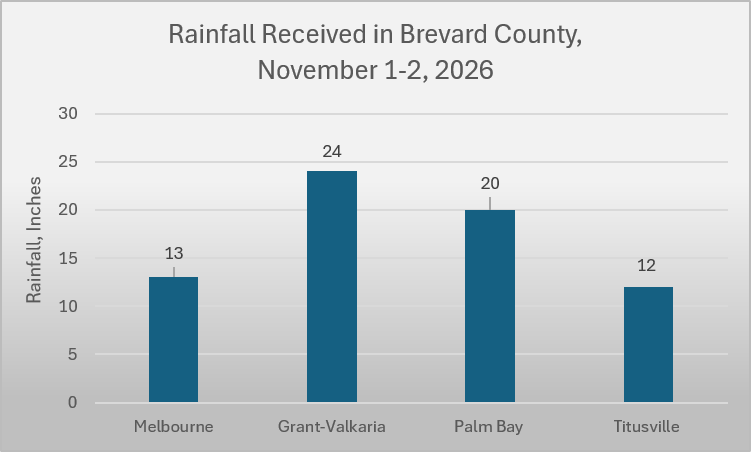
 Across DeLand, Astor, Melbourne, West Melbourne, and Palm Bay, historic rainfall-induced flooding has inundated roads, submerged docks, and threatened homes. Described as a “one in 1,000-year-event”, the deluge flooded communities across Central and Eastern Florida. The graphic to the right shows how many inches of rain several communities received.
On an average rainy day in November, a typical 24-hour rainfall amount ranges from 0.05 inches to 0.30 inches, with the entire month averaging only about 2.3 inches of total accumulation spread across roughly eight rainy days.
Record flooding throughout the watershed highlights a constellation of underlying issues, including urban sprawl into floodplains, the loss of wetlands, the loss of natural drainage corridors, increasingly severe weather events, and aging stormwater drainage systems. Together, these factors have altered the way water naturally moves through the landscape. These pressures weaken the St. Johns River watershed’s natural ability to store, absorb, filter, and gradually release excess rainfall, leaving surrounding communities vulnerable to flooding when extreme weather strikes.
Extreme weather events are increasing in intensity
As the climate warms, heavy downpours are becoming more frequent and intense across the Southeastern United States, according to the Fifth National Climate Assessment. Warmer air holds more moisture allowing storms to release heavier rainfall over shorter periods. Once the ground is saturated, each new downpour contributes to existing floodwaters rather than being absorbed into the ground.
Wetlands are essential natural infrastructure
Wetlands are the sponges of the St. Johns River, storing water that would otherwise flood communities and low-lying areas. However, unrestrained development and the expansion of impervious surfaces, such as roads and parking lots, disrupt these natural processes by increasing surface runoff. As these natural storage areas disappear in the Upper Basin, flooding intensifies downstream into the Middle Basin.
Aging drainage networks exacerbate flood risk
Florida’s current stormwater infrastructure may not be equipped to handle increasingly intense storms. Extreme precipitation combined with aging infrastructure can lead to prolonged flooding and diminished drainage capacity. High river levels make it even harder for stormwater outfalls to discharge. As a result, water backs up in drainage systems, leading to flooding in surrounding residential communities.
Extreme rainfall also increases risk of sewer and force main failures by overwhelming wastewater systems causing pipes to become surcharged and potentially rupture. These failures, along with inflow and infiltration overwhelming collection systems, can release untreated wastewater into streets and waterways. This week’s rains overwhelmed wastewater systems across the Upper Basin.
Flooding’s impacts aren’t borne equally
Low-income populations are more vulnerable to flooding’s negative impacts. Within the Upper Basin, neighborhoods in Cocoa West and Fellsmere have fewer resources to cope. In Cocoa West, Lake Poinsett continues to experience above flood-stage levels, leaving little protection for residents, a third of whom live in poverty. In Fellsmere, Latinx farmworkers face repeated flooding when heavy rain overwhelms the area’s canals and drainage systems.
Protecting the Upper Basin
We cannot control how much rain falls, but we can advocate for legislation that improves our watershed’s ability to handle it. Protecting wetlands, the natural systems that absorb, regulate, and clean water, is a central priority for us at St. Johns RIVERKEEPER.
Protect yourself + your community from extreme weather events
- Avoid floodwaters: They may contain sewage, bacteria, chemicals, and other contaminants.
- Never drive through flooded roads: Even shallow water can be dangerous.
- Know where to get alerts: Local emergency management, weather alerts, and evacuation notices.
- Protect drinking water: Follow local boil-water notices and drinking water advisories.
- Report sewage spills: Contact the appropriate utility or local authorities.
- Document property flooding: Take photos when safe to do so for insurance and recovery purposes.
If your home has been damaged or flooded by the rain, please contact Brevard County Emergency Management using this form.
To report pollution, contact St. Johns Riverkeeper and any appropriate local agencies.