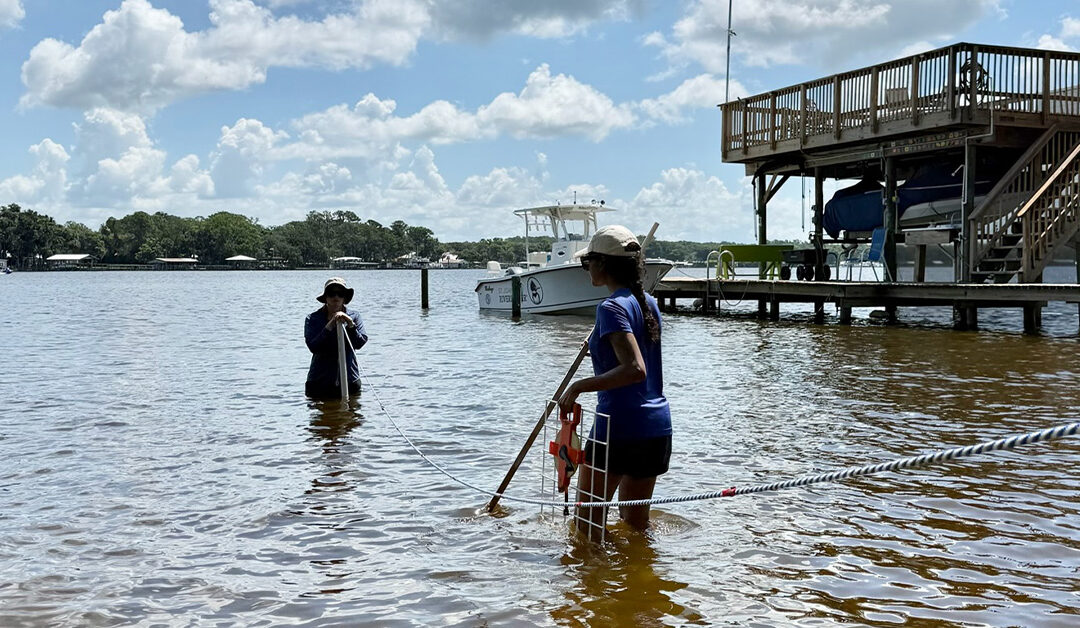
From May 19–22, St. Johns Riverkeeper (SJRK) surveyed its 80-mile study reach in the lower St. Johns River, marking the beginning of the fourth year of the SAVe Our River’s Grasses Expedition. This long-term effort is focused on documenting the remaining submerged aquatic vegetation (SAV) in this portion of the river and identifying solutions to restore this critical habitat.
In the spring of 2025, SJRK installed 10 protective enclosures at our already existing sites behind privately owned residential properties. These structures were designed to temporarily shield SAV from grazing pressure, allowing the plants an opportunity to develop enough underground biomass to remain established and grow despite environmental stressors. As part of our ongoing monitoring, we are comparing recovery rates inside the protected enclosures with those observed outside of them.
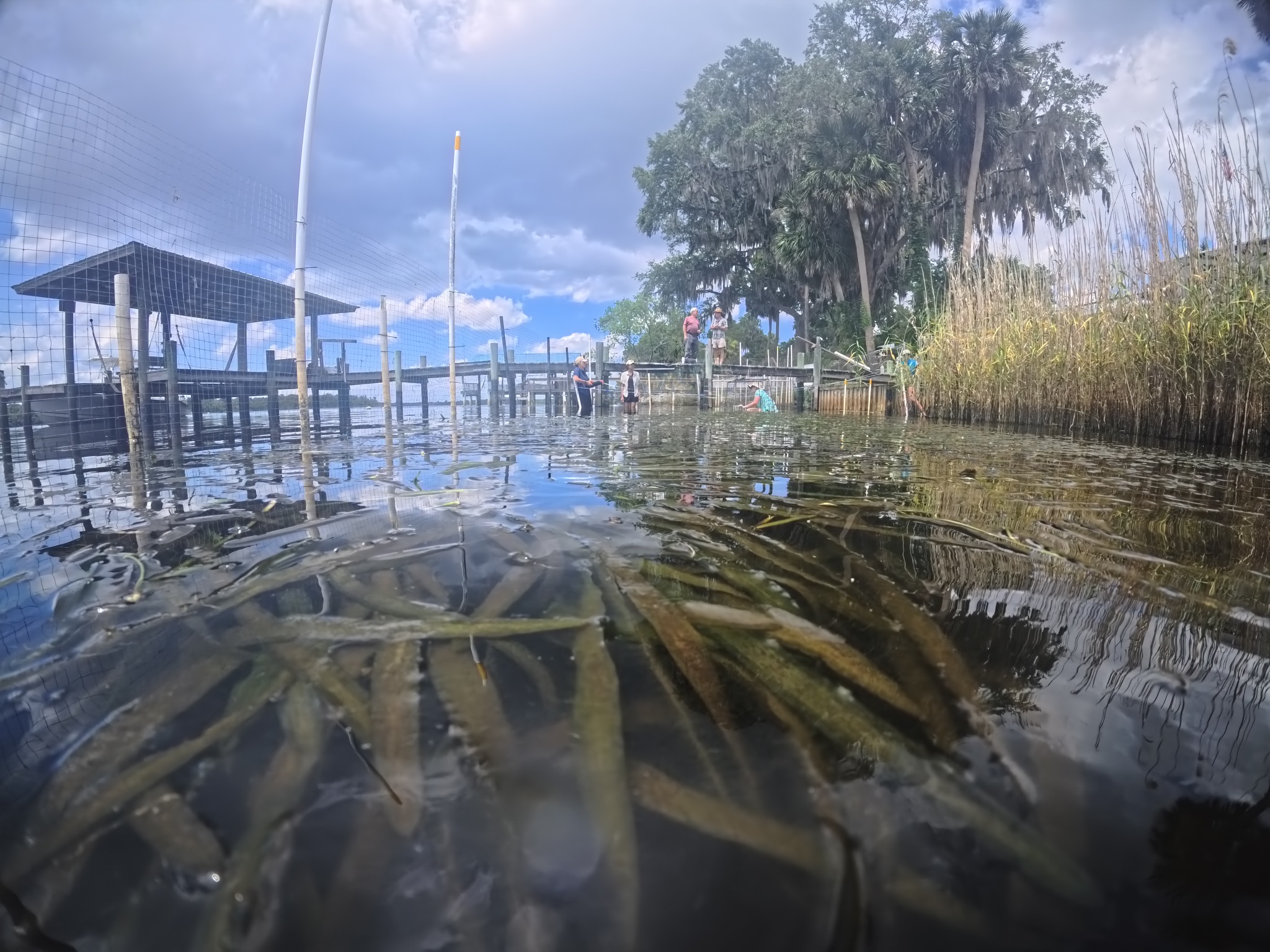
We found both encouraging and concerning conditions. The encouraging news is that SAV within the enclosures at most sites is improving, demonstrating that a viable native SAV seed bank still exists in many areas of the river. However, the grasses are often not recovering outside the protected areas at the same rate, if they recover at all. Multiple environmental stressors are limiting their ability to rebound, and even modest new growth can quickly be uprooted or consumed by grazers before the plants become established.
These findings reinforce an important point: the enclosures themselves are not a solution. We cannot fence off the entire river, nor would that address the underlying factors contributing to SAV loss. The enclosures are simply a research tool that allows us to better understand how SAV responds when grazing pressure is reduced or removed. By comparing conditions inside and outside these protected areas, we can identify the barriers preventing natural recovery and develop more effective restoration strategies. Under our permit, the enclosures will remain in place for two years, providing valuable data that will help guide future efforts to restore these critical habitats throughout the river.
May 2026 Overview of Findings
- St. Johns Riverkeeper completed their first survey of the year in May 2026 marking the beginning of the fourth year of the SAVe Our River’s Grasses Expedition.
- Our research continues to show a clear contrast between protected enclosure sites, where SAV can recover, and unprotected areas, where grasses remain sparse, stunted, or absent due to multiple environmental stressors.
- Several northern sites (including Fruit Cove, Orangedale, Colee Cove) showed strong SAV recovery inside enclosures, including increased canopy height, percent cover, and species diversity.
- Eelgrass reappeared at the Doctors Lake site after being absent during the previous sampling event, but was found only inside the enclosure.
- Our Palatka sites showed some recovery at a few of the enclosure sites.
- Sites ranging from Welaka to Georgetown demonstrated limited to no recovery. These sites are also plagued by chronically green water and substrate, where algae seems to be suspended throughout the water column.
- Water quality sampling identified cyanobacteria presence, including seven that are potentially toxin-producing species, reinforcing the influence of harmful algal blooms on SAV recovery.
- Nutrient pollution, especially phosphorus, remains a key driver of harmful algal blooms, reduced water clarity, and suppressed SAV recovery.
- Salinity stress increased in several areas due to drought and reduced freshwater inflows, with some sites approaching or exceeding optimal SAV tolerance ranges.
- Overall findings reinforce that SAV can recover under favorable conditions, but widespread restoration will require addressing multiple stressors, including nutrients, salinity, and water clarity.
- Continued research, including upcoming July and September field visits, will help refine restoration strategies and guide long-term river management decisions.
Learn More About the SAVe Our River’s Grasses Expedition
Detailed Findings
Clay and St. Johns County Sites
The first site, located in Doctors Lake in Clay County, provided a welcome sign of hope. SAV was once again documented at this location. While the grass remains short and was found only within the enclosure, it achieved an average percent cover of 28%. Although SAV has not yet been reestablished outside the protected area, these findings provide valuable insight into the factors influencing recovery and offer encouragement that restoration remains possible.
We are also encouraged by the results from our Fruit Cove site in St. Johns County. Recovery at this location began shortly after the enclosure was installed in May 2025 and became clearly evident by July 2025. During our May 2026 survey, Vallisneria (eelgrass) reached its highest recorded average canopy height at the site, measuring 33 centimeters (approximately 13 inches). Species diversity has also increased since the enclosure was installed, with Eleocharis spp. (spikerush), Ruppia maritima (widgeongrass), and Najas guadalupensis (guppy grass) now present alongside Vallisneria. Prior to installation, eelgrass was the only species documented at this site.
Our Orangedale site, located just north of the Shands Bridge, is also showing remarkable recovery within the enclosure. Similar to Fruit Cove, growth began to accelerate in July 2025. The site supports multiple SAV species and, during our most recent survey, recorded its highest average Vallisneria canopy height of 30 centimeters (approximately 1 foot) and an impressive 97% average percent cover.
The Colee Cove site in St. Johns County continues to exhibit some of the most impressive recovery observed in this initiative. By our September 2025 survey, average canopy height had reached an extraordinary 67 centimeters, just over 2 feet in length. Our May 2026 survey showed continued strong canopy height and percent cover while also revealing a potentially interesting development: eelgrass was documented outside the enclosure. Although this growth remains short with signs of grazing pressure and sparse, averaging approximately 28% cover, it raises the possibility that the SAV rhizome network may be expanding beyond the protected area. Future surveys will help determine whether this trend continues and whether recovery is beginning to extend into surrounding habitat.
These St. Johns County sites illustrate one of the central questions driving our research. The grasses clearly have the ability to grow and thrive when protected, yet they are not recovering outside the enclosures at the same rate, or, in many cases, at all. This suggests that multiple stressors are preventing SAV from reestablishing and growing quickly enough to withstand natural grazing pressure. By continuing to monitor these sites, we hope to identify the factors limiting recovery and develop science-based solutions that can help restore these critical underwater grass beds throughout the river.
Palatka Sites (Putnam County)
While several of our northern sites are showing encouraging signs of recovery, the results from our sites in the Palatka region were less promising.
At Mays Cove, we observed a few patches of taller eelgrass within the enclosure, but the site remains dominated by small, stunted, SAV. Species documented included eelgrass, spikerush, guppy grass, and muskgrass. Outside the enclosure, only sparse, short, and stunted eelgrass with clear signs of grazing pressure was observed.
Our Dancy Point site continues to struggle following the removal of the protective enclosure after a 2024 breach. While some vegetation was present, it consisted primarily of small, scattered patches of eelgrass with little evidence of substantial recovery.
Similarly, the Forrester Point site is showing only limited signs of improvement. A few sparse patches of vegetation were found within the enclosure, but growth remains short and stunted. Outside the enclosure, vegetation was nearly absent.
These Putnam County sites demonstrate that the removal of grazing pressure does not necessarily guarantee SAV recovery – environmental stressors such as water clarity, and nutrients continue to suppress growth and prohibit the reestablishment of healthy SAV.
Welaka-Georgetown Sites (Putnam County)
The conditions at the sites ranging from Welaka to Georgetown near Lake George are even more concerning. No SAV was documented within the Beecher or Floridian Club enclosures, and little to no SAV was found at Georgetowntown South, Drayton Island and Jenerson Point, with only small amounts of Chara observed. These sites continue to illustrate the significant challenges facing SAV recovery in portions of the river. It should be noted that the entire water column is always green in color, not just the bright green streaks or mats that are commonly observed. When algal presence is observed, we sample water and/or sediment to assess cyanobacteria abundance at a local lab; one goal of these assessments is to understand what impact this has to the root structure of SAV.
One exception is Georgetown North, which provides a glimpse of what may be possible when environmental conditions are more favorable. The site appears to benefit from shallower water depths, greater light penetration, and clearer water compared to neighboring locations. While SAV coverage remains limited overall, the highest canopy height recorded at this site reached an impressive 55 centimeters, nearly 22 inches, demonstrating that healthy growth can still occur under more favorable conditions.
These findings underscore that the factors limiting SAV recovery are not the same everywhere in the river. Some areas appear capable of supporting robust growth when grazing pressure is reduced, while others may be constrained by additional stressors such as water quality, light availability, sediment conditions, or other environmental factors. Understanding these differences is essential as we work to identify effective strategies for restoring this critical habitat throughout the St. Johns River.
A key factor for recovery of SAV in the St. Johns River is reducing nutrient pollution. Continued nutrient inputs, particularly phosphorus, fuel blue-green algal blooms (cyanobacteria), which reduce water clarity and directly limit SAV growth. Reducing nutrient loads is essential to decreasing the frequency and intensity of harmful algal blooms (HABs), improving water transparency, and ultimately supporting the reestablishment of native SAV (St. Johns River Water Management District, 2026).
To better understand site-specific conditions, we collected and analyzed water samples from 2 locations.
At Georgetown South, lab analysis identified seven types of potentially toxin-producing cyanobacteria. The most abundant was Raphidiopsis, at more than 16,000 filaments per milliliter. Other genera detected included Anabaenopsis, Dolichospermum, Cuspidothrix, Aphanizomenon, Microcystis, and Pseudanabaena. Many of these groups are known to include species capable of producing toxins under favorable conditions. A non-toxin-producing cyanobacterium, Planktolyngbya, was also present in high abundance. Overall, the results indicate a diverse and substantial cyanobacterial community at this site. A follow-up toxin analysis found toxins detected in saxitoxin at a concentration of 0.12 µg/L, fortunately below the recreational guidance value and overall cyanotoxin activity at the site was low at the time of sampling.
At Drayton Island, water and sediment analyses revealed six types of cyanobacteria, also dominated by Raphidiopsis at more than 9,000 filaments per milliliter. Additional genera included Anabaenopsis, Aphanizomenon, Cuspidothrix, Pseudanabaena, and Microcystis. As with Georgetown South, Planktolyngbya was also present in high abundance. While several species were difficult to distinguish under the microscope due to their similar morphology, the overall community reflects conditions commonly associated with bloom-prone waters.
Salinity is another key stressor affecting SAV in the St. Johns River. This year’s drought conditions, combined with reduced freshwater influxes, resulted in some of the highest salinity levels we have recorded at several sites, particularly in the more northern portions of the study area, including Doctors Lake through Colee Cove.
SAV in the lower St. Johns River is generally classified as experiencing salinity conditions ranging from “likely under stress” to “extreme stress.”. Eelgrass (Vallisneria) can tolerate salinity up to approximately 10 ppt. However, optimal growth and recovery typically occur within a much narrower range of 0.5–5 ppt. Extended exposure of Eelgrass to salinities above 5 ppt places SAV under stress and causes SAV to require approximately 50% more light, according to a 2025 report by St. Johns River Water Management District (Timbs et al., 2025). According to this same report, higher salinities in the Lower basin may also elevate sulfate levels, leading to sediment sulfide production under anoxic conditions. Sulfide is toxic to SAV, as it interferes with nutrient uptake, photosynthesis, and cellular enzyme functions.
Refilling the Rodman Reservoir this past Spring during the drought may have further elevated salinity levels in portions of the St. Johns River.
When the Rodman Reservoir is refilled following a drawdown, freshwater that would normally flow downstream through the Ocklawaha River is instead retained behind the dam. This reduction in freshwater discharge further limits downstream flow into the St. Johns River system.
With decreased freshwater input, tidal influence from the Atlantic Ocean can extend farther upstream in the St. Johns, contributing to increased salinity in affected areas. Historically, the Ocklawaha River provided a significant source of freshwater to the St. Johns. The dam and reservoir system alter both the timing and volume of that flow, and during refill periods even more water is held back rather than contributing to downstream river discharge.
During the May period, we recorded elevated salinity levels across multiple sites. At Fruit Cove, salinity reached 9.4 ppt, more than double the level observed during the same period in 2025 (4.0 ppt), representing a 135% increase.
At Orangedale, salinity reached 6.2 ppt, more than four times the level observed during the same period in 2025 (1.5 ppt), representing a 313% increase.
In Colee Cove, salinity reached 4.5 ppt, approximately 7.5 times higher than the level observed during the same period in 2025 (0.6 ppt), representing a 650% increase.
At our Doctors Lake site, salinity reached 10.3 ppt, more than twice the level observed during the same period in 2025 (4.5 ppt), representing a 129% increase.
These values indicate that several areas are approaching or exceeding thresholds where SAV growth becomes increasingly stressed or inhibited, particularly during extended dry conditions.
We will be back in the field in July, with our final survey of 2026 in September. We look forward to continuing this work and sharing the findings as they emerge from these upcoming field events.
The insights gained through this research inform future restoration efforts and strengthen our advocacy for policies that improve water quality and habitat conditions throughout the river.
Each field season continues to add valuable data that deepens our understanding of the challenges facing our river grasses and the actions needed to bring them back.
None of this work would be possible without the continued support of our members, partners, and the homeowners who generously allow access to their properties for field research. Their investment in the river is helping advance the science needed to restore our river’s grasses.
Learn More About the SAVe Our River’s Grasses Expedition