
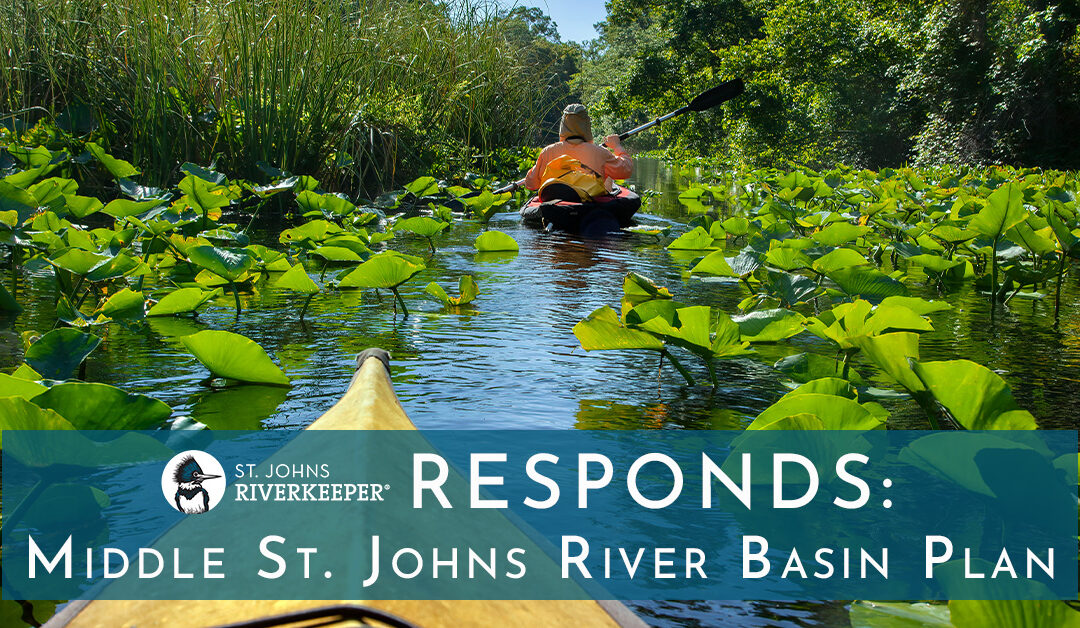
St. Johns Riverkeeper submitted a public comment on the St. Johns River Water Management District’s draft Middle St. Johns River Basin Plan, outlining opportunities to strengthen protections for the beloved springs, rivers, lakes, and wetlands comprising the Middle Basin.
Our comments highlighted several key priorities, including updating outdated water-quality targets, establishing measurable restoration goals, aligning activities with current nutrient reduction needs, improving wastewater and septic infrastructure, and preparing for the impacts of continued population growth and extreme weather events.
- Lake Jesup remains under significant nutrient stress. Total phosphorus concentrations are still more than twice the basin’s 2009 restoration target, underscoring the need to address both legacy pollution in the lake and ongoing nutrient inputs from stormwater, wastewater, and septic systems.
- Are restoration projects keeping pace with the scale of pollution? The Middle Basin BMAP’s required-reduction milestones illustrate the scale of the challenge, calling for reductions of 87,656 pounds of nitrogen and 17,710 pounds of phosphorus per year by 2032. Thus, the Basin Plan should clearly quantify how proposed restoration projects will address the magnitude of nitrogen and phosphorus entering impaired waters.
- Aging wastewater and septic infrastructure continue to threaten water quality. The Middle Basin contains more than 163,000 septic tanks, while recent sewage spills demonstrate the vulnerability of wastewater infrastructure during major rainfall events. Stronger infrastructure investments, stormwater retrofits, and septic-to-sewer conversions are essential to ensuring the long-term health of the Middle Basin.
- Upstream pollution affects the entire basin. Approximately 70% of nitrogen and phosphorus loading to Lakes Harney and Monroe originate upstream, highlighting the need to address these nutrient sources – including sewage sludge applications in the Upper Basin – as an integral part of the Middle Basin’s restoration strategy.
- Plan for growth and water demand. Central Florida’s continued population growth will increase pressure on both water quality and water supply. The Plan should account for cumulative impacts from development, groundwater withdrawals, wastewater, and stormwater, thereby ensuring that future water demand does not come at the expense of springs, rivers, and lakes.
- Build resilience into basin management. Increasing risks from drought, extreme rainfall, flooding, and mounting heat should be incorporated into restoration and water-resource planning so that the Basin Plan prepares the watershed for future conditions, and not just those of the past.
A full copy of our public comment can be found here.
St. Johns Riverkeeper will continue to work with, and hold accountable, state agencies as we protect the entire 9,000 square mile watershed of our St. Johns River. The Middle St. Johns River Basin Plan is a good start, but we must ensure the agencies tasked with protecting our local water resources use a holistic approach — one that accounts for and addresses the confluence of threats facing the river and the communities that rely on it.